
I chatted to Laurium’s Brian Thomas about how they think about risk management in running the Amplify SCI Balanced Fund.
In running the Amplify SCI Balanced Fund, Laurium’s thinking around risk management starts in a novel place.
“One of the big things we think about is probably not a conventional definition of risk,” says co-portfolio manager Brian Thomas. “When we consider the investors in the fund, the biggest risk they face is that they might retire without enough money.
“That feeds into how we think about this fund. We’ve always run it very high equity relative to the high equity category, because over time we believe in the equity risk premium that you receive over other asset classes.”
Over long periods of time, South African equities have delivered around a 5% return premium over local bonds. Laurium therefore takes the view that navigating the biggest risk that investor’s face – not having enough retirement capital – requires a high level of exposure to the asset class.
“If the individuals invested in this fund might not have enough cash to retire on, we need to generate the best return that we can to prevent that eventuality.”
“That’s our top-level philosophy around risk,” Thomas says. “If the individuals invested in this fund might not have enough cash to retire on, we need to generate the best return that we can to prevent that eventuality.”
He acknowledges, however, that equity does carry other risks, and therefore having a clear asset allocation framework to diversify some of that risk is critical.
“We run all of our multi-asset funds to what we call a base case – what others might refer to as a strategic asset allocation,” Thomas says. “That is what we think the average asset allocation should be over time to achieve a certain target.”
This is established using statistical modelling to identify the optimal portfolio weightings.

“Most recently we used the Black–Litterman model to get to what we think the base case should be,” Thomas (pictured above) explains.
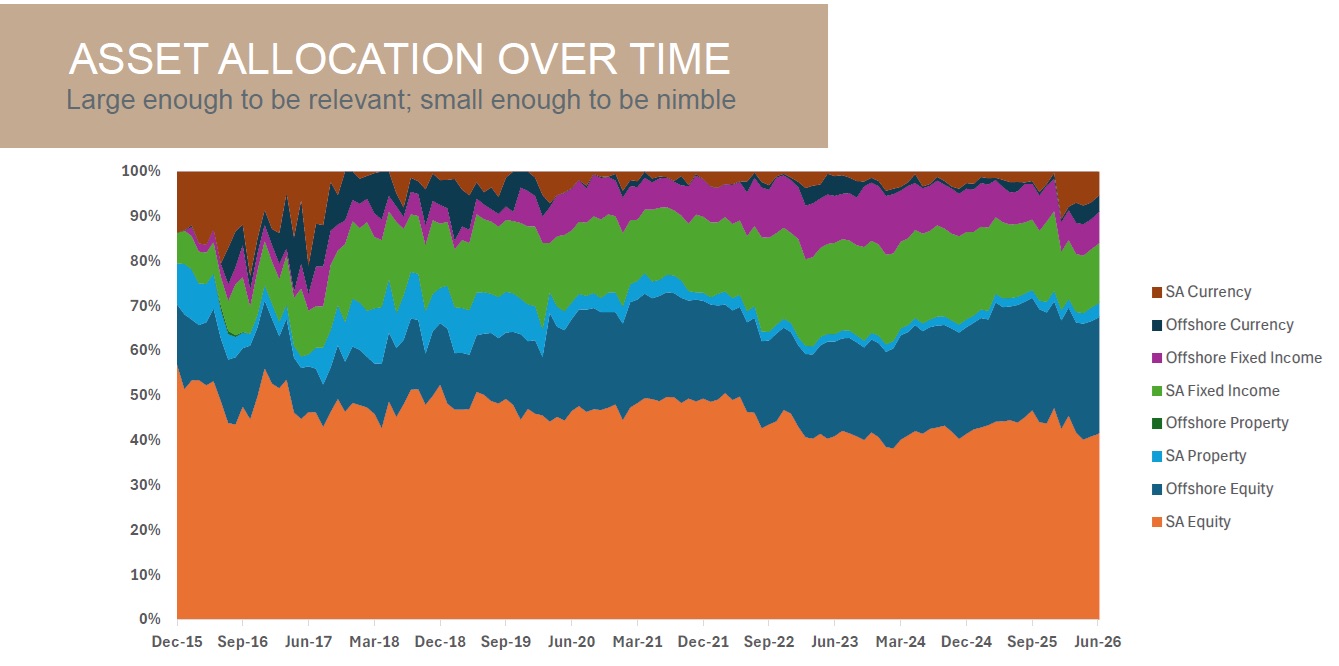
In the Amplify SCI Balanced Fund, the base case allocation to equities is 70%. This is split between 42% in South African stocks and 28% offshore.
“On top of that, we then have an ongoing approach to asset allocation,” Thomas says. “Every quarter we get everyone on the asset allocation committee to independently send in what their asset class forecast over the next year, and we aggregate those.
“There are a few bald heads and grey hairs in the team – myself, Murray Winckler, Gavin Vorwerg, Rob Oellermann – so there’s a lot of experience. In addition, Shwebi Gqosha contributes years of fixed income experience. We also take into that process forecasts from the rest of our investment team. For instance, Mike Lawrenson and Junaid Bray will submit asset class forecasts.”
The aggregate forecasts inform how the portfolio should be tilted relative to the base case.
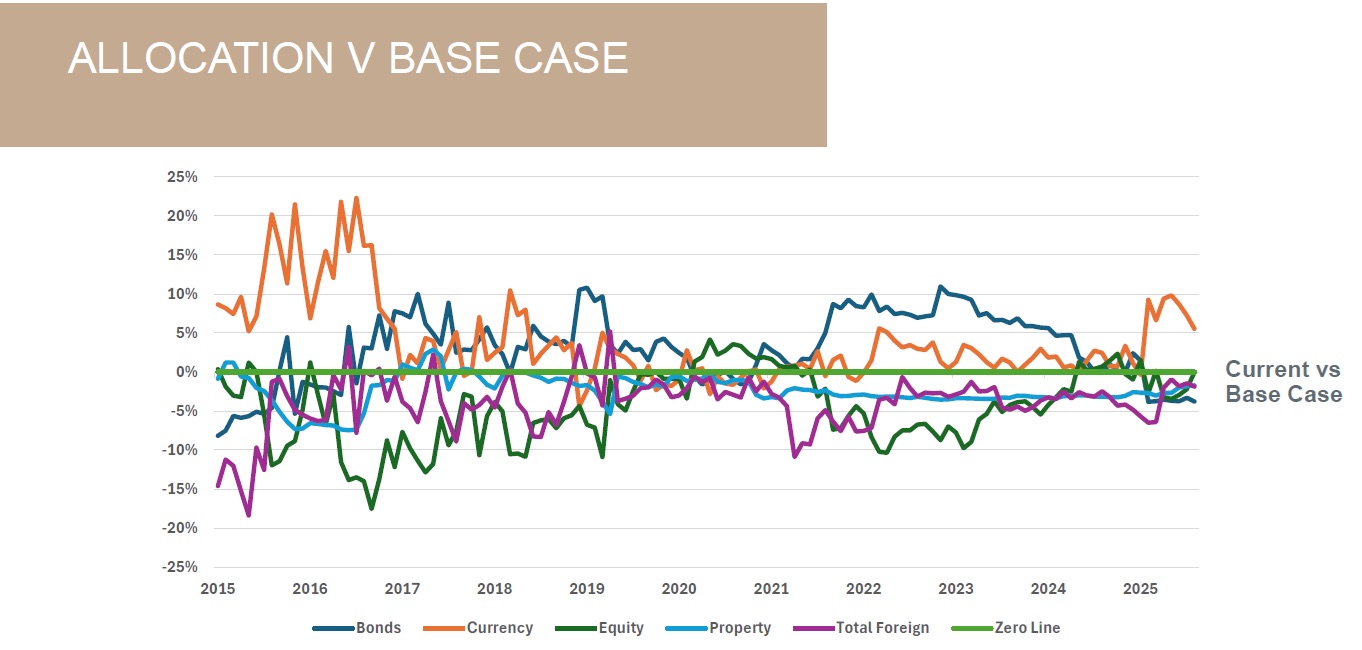
“We don’t focus on the point forecasts,” Thomas says. “When we review those, it’s humbling how wrong we can be. But directionally we mostly get things right in terms of how asset classes are likely to perform relative to each other.”
This quarterly review is unlikely to result in big changes in the portfolio. It mostly serves to check that the portfolio is aligned with expectations.
“If, on aggregate, the team is forecasting much higher returns for domestic equity relative to foreign equity, but the portfolio is skewed to offshore, then we would need to make a change,” Thomas explains. “But it’s seldom that we make big trades after these quarterly meetings, because we iterate our asset allocation over time.”
Another element of Laurium’s risk management is monitoring both portfolio duration and the duration of the fixed income carveout.
“With portfolio duration, we are looking at how the bond component and equity component jive with each other,” Thomas says. “Equities have their own effective duration and their responsiveness to interest rates just as bonds do, and the interface between bonds and equities on that basis is important.
“We then also look at the bond component independently and what duration risk we are exposed to there.”
Within the equity portion of the fund, Laurium also monitors factor exposures and what risks the portfolio may be taking on inadvertently.
“Every day, we send out our morning sheet to everyone in the company showing our factor exposures in each fund.”
“We became quite fastidious about this after Brexit,” Thomas says. “Our portfolios took a drawdown after that vote because we hadn’t realised that we had a big GBP factor exposure through Old Mutual, British American Tobacco etc. So, when the pound got hammered, we got hammered.
“Now, every day, we send out our morning sheet to everyone in the company showing our factor exposures in each fund. I think that’s a very interesting approach to risk because anyone on the team can come to me at any time and say, why are we running such a high exposure to something. It’s open to challenge.”
Thomas adds that the final piece is then mitigating the unseen risks through hedging.
“For example, in January this year we had been very overweight SA government bonds, but we recognised that they had run and our forecast was that we weren’t going to get much more than the running yield. So we rotated out of those bonds into a combination of domestic and foreign equities.
“But foreign equities were looking reasonably full, and SA equities had also run hard, so we hedged that equity exposure. We want to do that where we see higher than normal market risk.”
Article from Running Yield
.svg)


